Circular Clothing PilotCircular Food PilotProject UpdatesResearch and Insights
Measuring household climate impact: First insights and the CARE CO₂ Tool

How much impact do everyday habits really have on the climate? As discussions around responsible consumption gain attention across Europe – particularly around World Consumer Rights Day – new insights from the CARE project highlight how informed choices can contribute to climate action.
First insights from the project’s baseline assessment are now available. At the same time, the CARE Carbon Footprint Tool helps households estimate their impacts by tracking food, clothing and laundry behaviours. The digital tool is currently being piloted with more than 100 households across Europe.
First insights from the baseline assessment
Within the EU Horizon Europe project CARE, another milestone has been reached: the baseline assessment has now been finalised. A total of 141 households from Estonia, Finland, Germany, Norway and Sweden have participated, either in the food or in the clothing pilot, focusing on the transition towards more sustainable habits. Based on the results of a 14-day food waste diary completed by 67 households, participants discarded a total of 164 kg of edible food. This corresponds to an average of 172 g per household per day.
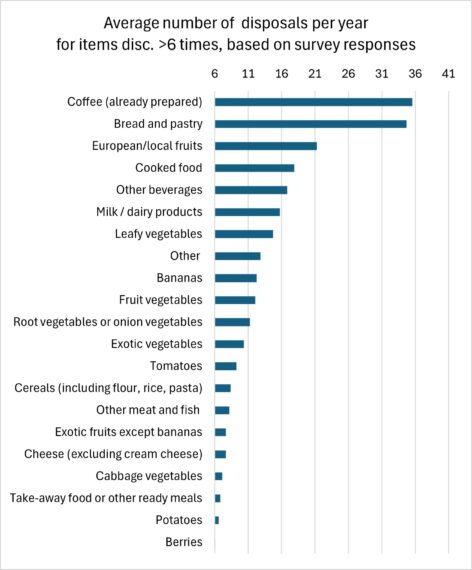
Average number of food disposals per year for commonly discarded food items based on survey responses from participating households. Results from the baseline assessment conducted within the CARE project. | Source: CARE baseline assessment (Institute of Waste Management and Circularity, BOKU University)
The climate footprint of the observed edible waste is substantial. It corresponds to approximately 340 kg CO2e, which is roughly equivalent to the emissions generated by driving about 2,800 km by car. On an annual basis, this equates to around 73,000 km of driving, which is more than one and a half times around the Earth’s equator (approximately 40,475 km). First insights suggest that bread, coffee, and tomatoes are among the most frequently discarded items. This aligns with households’ self-assessments: participants reported that bread and pastries, as well as coffee, are among the items most often wasted.
Preliminary results on the climate impact of clothing habits indicate that the largest share of impact stems from the acquisition of clothing, as most households purchase new items rather than second-hand garments or clothing obtained through swapping. The second largest phase is transportation, both when acquiring the clothing items and when disposing of them. Interestingly, the use phase (i.e. washing and drying) accounts for a comparatively smaller share of the household’s climate impact.
From baseline insights to behaviour change
In the next phase of the project, CARE’s mission is to reduce both wastage and the associated carbon emissions, with a strong focus on practical measures that support sustained behaviour change.
Because emissions vary widely between products, preventing waste in high-footprint foods such as meat and dairy can generate particularly large climate benefits, even when the quantities wasted are relatively small. At the same time, there are straightforward actions that can significantly reduce waste in commonly discarded items.
CARE’s advisory services provide targeted guidance to participating households and maintain ongoing contact to support everyday decision-making. The objective is clear: reduce avoidable food waste, prioritise high-impact items, and achieve measurable reductions in CO2 emissions as participation grows and recommendations are refined against the baseline results.
The CARE CO₂ Tool: Supporting informed household choices
As part of the CARE project, a new digital tool has been developed to demonstrate how small everyday changes can positively influence climate outcomes. The web-based CARE CO₂ Tool helps households better understand their carbon footprint and identify opportunities for reducing emissions, particularly in the areas of
- Food: Reducing food waste and making more conscious consumption choices
- Clothing: Choosing sustainable and long-lasting textiles
- Laundry: Using energy efficiently and washing in a resource-saving way
The tool shows how even relatively small adjustments – such as wasting less food, selecting clothing more carefully or washing more efficiently – can lead to measurable CO₂ savings. Progress is automatically recorded so that participants can track their impact over time.
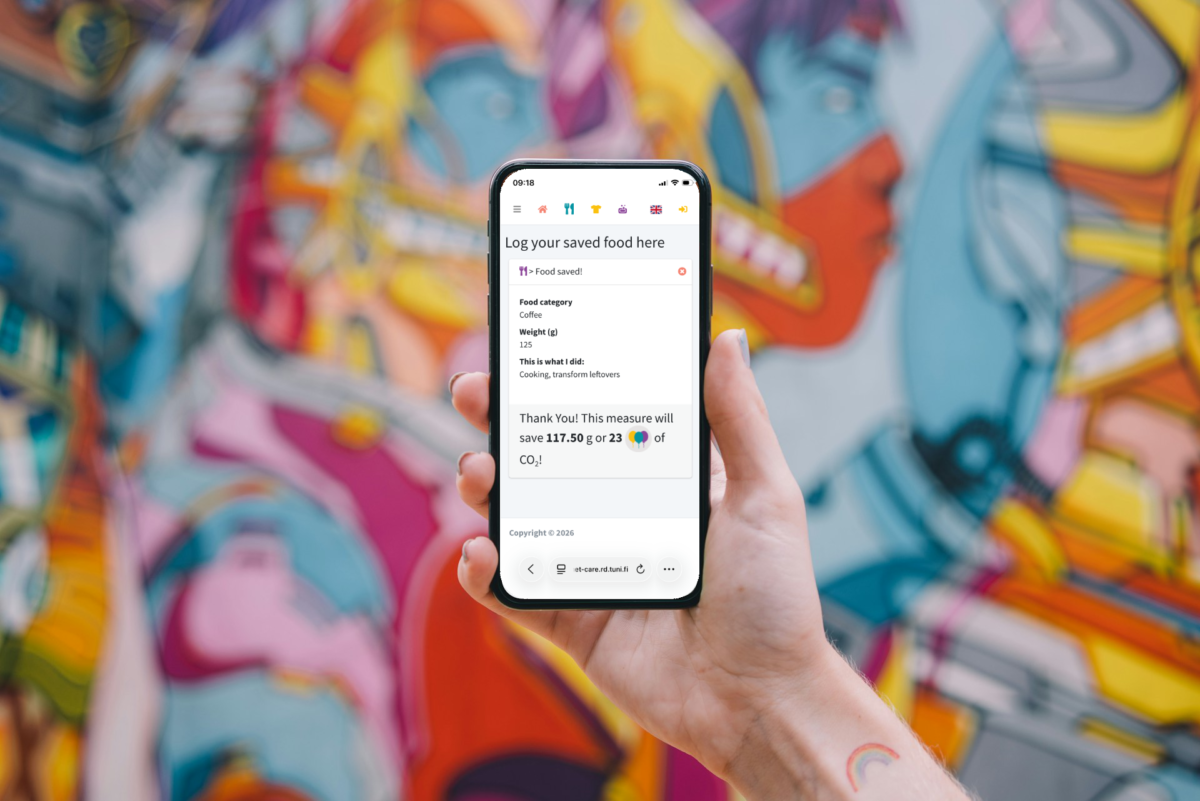
The CARE CO₂ Tool helps households track how everyday actions – such as reducing food waste – translate into measurable CO₂ savings over time. | Photo by Abillion | Unsplash | Screen edited by CARE
From pilot phase to wider application
The tool is currently available exclusively to households participating in the CARE project, where it serves as a motivational resource and a tool for raising awareness of personal resource use.
Following the pilot phase, so in 2027, the CARE CO₂ Tool will be made publicly available, allowing households across Europe to benefit from it. The overarching goal is to support people in making their everyday lives more sustainable – step by step. In the context of World Consumer Rights Day, the tool also highlights the role of informed consumer choices in addressing climate change and promoting more sustainable consumption patterns.
A shared objective
These activities form part of the wider CARE project, an EU-funded initiative running until 2027 and implemented in five European countries: Finland, Norway, Sweden, Germany, and Estonia. The project aims to promote sustainable lifestyles in households and contribute to climate change mitigation.
The Institute of Waste Management and Circularity at BOKU University in Vienna, Austria is one of eleven project partners and is responsible for evaluating the project’s outcomes. Using scientific methods such as life cycle assessment and ecological footprint analysis, the project measures progress in material efficiency, living conditions, and sustainable well-being while quantifying the associated environmental impacts.
Explore the science behind circular living
Understanding how everyday habits influence climate impact is an important step towards more sustainable lifestyles. The CARE project brings together researchers, municipalities and practitioners across Europe to analyse household practices and develop practical solutions for circular living.
If you are working on topics such as circular consumption, household behaviour, life cycle assessment or climate impact monitoring, we would be happy to exchange ideas. For questions related to the evaluation methods and the CARE CO₂ Tool, feel free to get in touch with Gudrun Obersteiner from the BOKU research team.
To stay informed about new findings, tools and project updates, follow CARE on LinkedIn, Bluesky or Instagram and subscribe to our newsletter.
Together with CARE, we transform our world for the better.
Contribution: Elisabeth Schmied, Gudrun Obersteiner, Silvia Schütz, Frida Hermansson
Header Image: xy
Related posts
Circular Clothing PilotCircular Food PilotLocal EngagementPartner Spotlight
From participation to practice: Ecofellows supports circular change in Tampere
Through local pilots, practical guidance and hands-on learning, Ecofellows helps households test more circular food and clothing practices. Within …
Aug 27, 2026