Circular Food PilotEventsResearch and Insights
When sustainability reaches the kitchen: Making food transition tangible
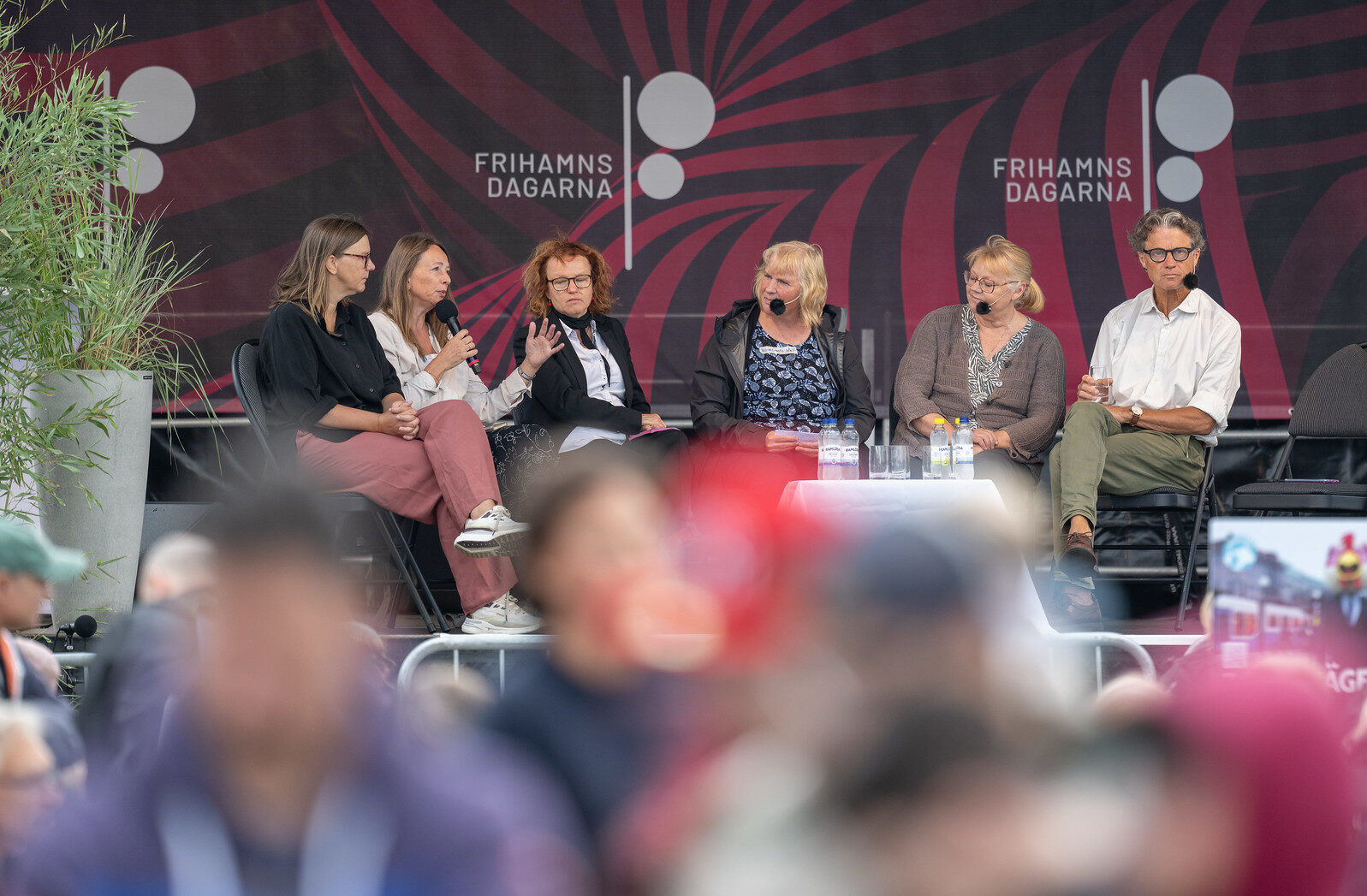
At Frihamnsdagarna 2026 in Gothenburg, CARE researcher Annelise de Jong and a participating household joined researchers, municipal representatives, civil society and young people to explore a deceptively simple question: What does it take to turn sustainable food ambitions into practices that actually work in everyday life?
Food is one of the most ordinary parts of our lives. We shop, cook, open the fridge, decide what still looks good and occasionally discover something at the back that we had forgotten was there. At the same time, these apparently small decisions are connected to much bigger questions about climate, resilience, public health and the future of our food system.
That distance between the big picture and the kitchen table was at the heart of the panel discussion “Food transition for everyone – how do we make the future tangible?” at Frihamnsdagarna in Gothenburg. The panel brought together perspectives from research, municipal government, civil society and citizens – including young people – and asked not only what needs to change, but how change can become understandable, practical and relevant to different people.
CARE brought a particularly close-up perspective to that conversation. Annelise de Jong from IVL Swedish Environmental Research Institute joined the panel together with a participant from CARE’s Gothenburg food pilot. One researches everyday consumption practices; the other experiences the project within her own household.
Knowing what to do is only the beginning
There is certainly no shortage of information about sustainable food. And yet knowledge alone does not necessarily tell us what to cook tonight, how to organise a crowded fridge or which sustainability advice deserves our attention when time is short.
The scale of the challenge is substantial. In 2024, Swedish households discarded around 16 kilograms of food per person that could still have been eaten, while households accounted for more than 70 per cent of food waste generated at retail and consumer level. Food and drink poured down the drain are not included in that figure (cf. Naturvårdsverket, 2025).
CARE approaches this gap between knowledge and practice by working with households rather than simply communicating recommendations to them. Across five European countries, participants test different ways of making food and clothing consumption more circular. Annelise described how much knowledge already exists within the households themselves and how willing participants are to exchange ideas, discuss challenges and learn from one another. Researchers and experts add further perspectives, for example on storing food or cooking with leftovers, but the process does not begin with researchers telling households what they ought to do.
“There is so much knowledge and such a strong willingness to learn from one another, share tips and build new routines from the bottom up.” — Annelise de Jong, IVL
This may sound like a subtle distinction, but it changes the role of the household. People become more than recipients of sustainability advice. Their routines, constraints, ideas and experiences become part of the learning process itself.
A real kitchen has its own logic
That became particularly tangible when the CARE household participant described what the project had meant in her own everyday life.
Policy documents, she explained, can feel far removed from what happens at home. Advice such as freezing food or using up leftovers may already be familiar. The more interesting question is what comes next: How do you go deeper? How do you make an idea work with the fridge you actually own, the habits your household already has and all the other things competing for attention?
The workshops gave her new ways of looking at familiar routines. What mattered was not simply receiving another set of tips, but having the opportunity to explore them in relation to her own household.
There is another side to this. Sustainable consumption can easily become overwhelming. When food comes with questions about origin, climate impacts, health, animal welfare, waste and packaging, doing the “right” thing can start to feel like a full-time research project. The household participant described the CARE experience as positive precisely because it opened up new possibilities without turning them into another list of obligations. That, she said, made her more curious and more receptive to changing routines.
The workshops have given me many new ways of thinking. That makes it easier to become curious and adopt different ideas, rather than being faced with another list of things you have to do. — CARE household participant, Gothenburg
(NOTE: Translated from Swedish; final wording to be confirmed by IVL.)
Her contribution also connected with something the younger participants on the panel raised later in the discussion: even the language of sustainability can create distance. They questioned why concepts such as organic food are so often explained using terminology that young people do not readily understand. If transformation is intended to include everyone, they argued, then people first need to understand what is being discussed and why it matters.
The choice may be individual. The conditions are not.
The panel did not produce one neat recipe for transforming the food system. Some contributions emphasised municipalities and public procurement as levers for change. Others focused on local food production, community-based experimentation or the need to build stronger relationships between producers and consumers. There was even disagreement over whether today’s food system can be transformed sufficiently from within or whether alternative models need to grow alongside it. What connected many of these perspectives was the recognition that individual motivation has limits.
Towards the end of the discussion, the CARE household participant returned to this point from a very practical angle. She wants to make sustainable choices, she said, but food systems are not her professional field. Like most people, she cannot investigate every product, production method and environmental consequence before deciding what to buy. The places where people shop, the information available to them and the way choices are presented therefore matter too. People need guidance, but in a form that remains manageable in everyday life.
That observation reaches well beyond one household. If a sustainable option requires exceptional knowledge, money, time or motivation, it will remain exceptional. Researchers, municipalities, businesses and civil society therefore have another question to answer alongside the familiar one of how to encourage behaviour change: What needs to change around people so that more sustainable practices become easier to maintain?
This is also why CARE looks beyond individual decisions. The project examines practices as combinations of skills, meanings, materials, services and social contexts. A household can learn how to store food differently, but whether that practice becomes part of daily life depends on much more than having received the correct information once.
A future that feels possible
Towards the end of the panel, Annelise introduced resilience into the discussion. Sustainability and preparedness, she argued, do not have to be separate agendas. Using resources more intelligently, strengthening local capacities and thinking differently about food can support both.
But she also returned to everyday life. New practices need to fit into it. They should be resource-smart, practical and, where possible, enjoyable. Perhaps this is what making a transition “tangible” ultimately means. Not reducing a complex food system to a handful of individual choices, and not asking people to carry the responsibility for transformation on their own. It means creating opportunities to understand change, experience it, question it and discover what it might look like in a real household, school, neighbourhood or city.
The panel began with a question about how to make the future more graspable. The discussion did not provide one vision of that future. Instead, it showed why many perspectives are needed to build it. For CARE, there is a practical lesson in that: change becomes more credible when people do not only hear about it, but have the opportunity to try it for themselves … and help shape what comes next.
Continue the conversation
The full panel discussion Food transition for everyone – how do we make the future tangible? is available online in Swedish.
Watch the recording from Frihamnsdagarna 2026:
You are currently viewing a placeholder content from YouTube. To access the actual content, click the button below. Please note that doing so will share data with third-party providers.
Header image: © Winterskiöld Photography
Related posts
Circular Clothing PilotCircular Food PilotLocal EngagementPartner Spotlight
From participation to practice: Ecofellows supports circular change in Tampere
Through local pilots, practical guidance and hands-on learning, Ecofellows helps households test more circular food and clothing practices. Within …
Aug 27, 2026